
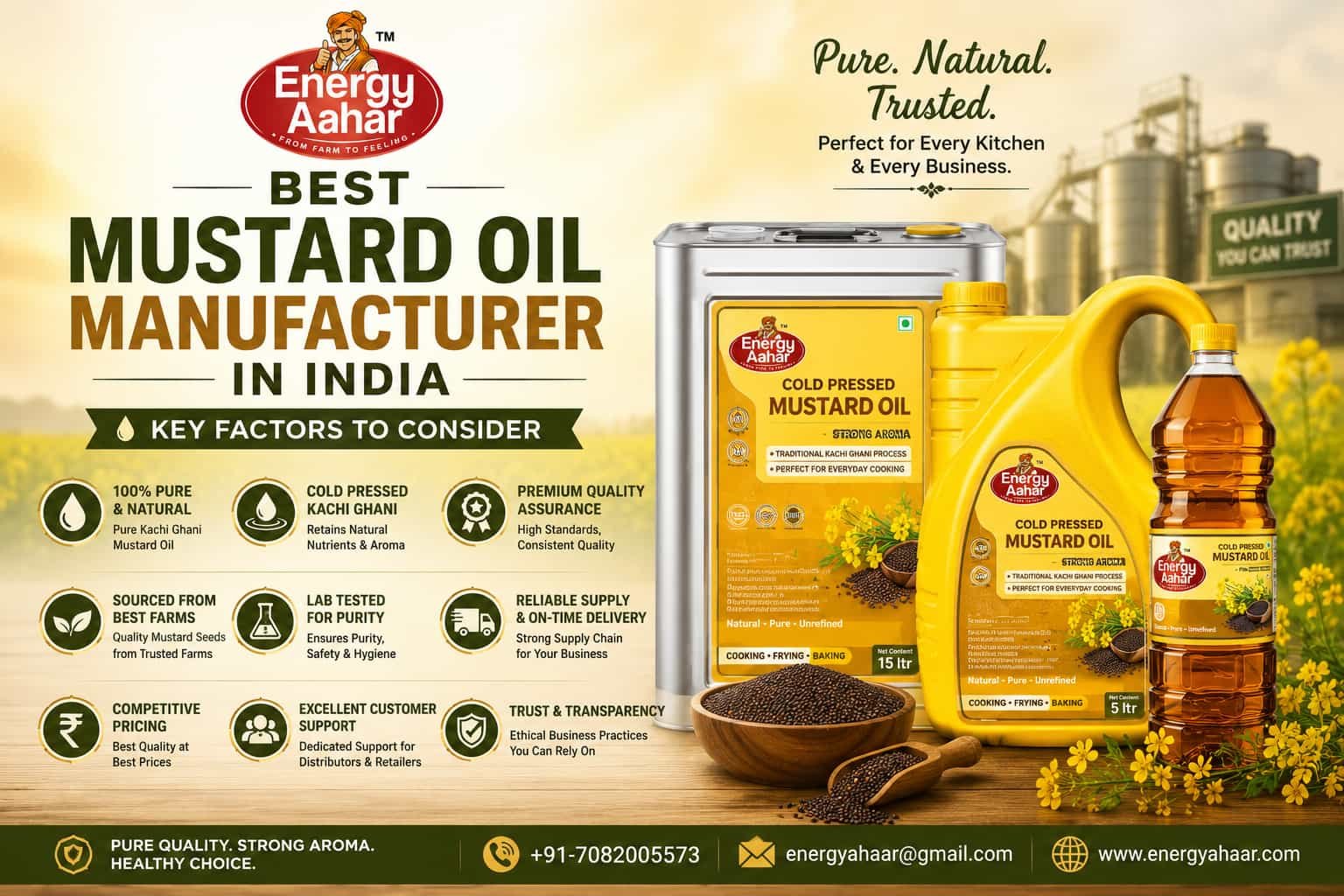
Best Mustard Oil Manufacturer in India: Key Factors to Consider
The best mustard oil manufacturer is one that cold-presses using the traditional kacchi ghani method, sources seeds consistently from the same growing regions, backs up purity claims with FSSAI certification and real testing, and packages the oil to protect it from light and air. Energy Aahar builds its process around exactly this — which is why it's worth putting at the top of your list.
Walk into any Indian kitchen and there's a good chance a bottle of mustard oil is sitting somewhere near the stove. It's not just cooking oil here—it's massage oil for babies, it goes into pickles that last a whole year, and in a lot of households it's the only oil anyone will use for frying. So when people go looking for the best mustard oil manufacturer in India, they're not being fussy for no reason. The stuff touches too many parts of daily life to get wrong.
Two bottles can look identical on a shelf and behave completely differently once you open them. Here's what actually separates a manufacturer worth trusting from one that's just filling bottles.
What Actually Separates a Good Manufacturer From a Mediocre One
| Factor | What good looks like | What to watch for |
|---|---|---|
| Seed sourcing | Same growing regions year after year, often direct from farmers | Sourcing shifts to "whatever's cheapest that season" |
| Extraction method | Cold-pressed / kacchi ghani — seeds crushed slowly without heat | Solvent extraction or high-heat pressing (faster, cheaper, flatter taste) |
| Purity claims | FSSAI certification plus actual lab testing behind the label | "100% pure" printed with nothing to back it up |
| Packaging | Bottling designed to block light and air | Bottles that look nice but let the oil degrade in a few months |
| Track record | Repeat customers, consistent product batch to batch, years in operation | Quality that quietly slips whenever input costs rise |
| Pricing | Priced in line with what quality inputs and slow extraction actually cost | Suspiciously cheap, or expensive with no clear reason why |
Why Seed Sourcing Matters More Than People Think
Mustard oil starts with mustard seeds, and the seeds start with soil, water, and a farmer somewhere. A manufacturer sourcing from wherever's cheapest that season ends up with oil that's inconsistent — sometimes fine, sometimes not. The ones worth paying attention to work with the same growing regions year after year, often directly with farmers instead of through several layers of middlemen.
Energy Aahar sources its mustard seeds this way — consistently, not opportunistically — and that discipline is what shows up as batch-to-batch consistency once the oil is bottled.
The Extraction Method Changes Everything
How the oil is pressed out of the seed matters as much as the seed itself. The traditional method is cold-pressing — the kacchi ghani process — where seeds are crushed slowly without heat. This keeps the natural pungency, the sharp aroma, and most of the nutrients intact. Compare that to solvent extraction with high heat: faster, cheaper, but you lose most of what makes mustard oil worth using in the first place.
Energy Aahar still uses the traditional cold-pressed method, and it's upfront about it. It's the biggest reason the oil tastes like what people remember from their grandmother's kitchen instead of something flatter and more processed.
Purity Isn't Just a Marketing Word
"100% pure" gets printed on a lot of labels that don't deserve it. Adulteration in mustard oil — cheaper oils mixed in, or worse — has been enough of a problem that regulators have stepped in over the years. Purity claims need something behind them: lab testing, clear sourcing, and certifications that aren't just decorative logos.
Energy Aahar keeps its production compliant with FSSAI food safety standards, and treats the sourcing and pressing process itself as the thing that backs up the purity claim — not just words on a label.
Packaging and Storage Are Easy to Overlook
Mustard oil is sensitive to light and air. Bottle it wrong and it starts to lose its edge — the pungency fades, and it can go rancid faster than it should. Open a bottle three months old that was packaged carelessly, and it can smell like nothing at all. Manufacturers who think this through use packaging built to actually protect the oil, not just packaging that looks good on a shelf.
Reputation Built Over Time, Not Just Online Reviews
Reviews help, but they're easy to game and hard to trust completely. What tells you more is whether a manufacturer has a real track record — repeat customers, word of mouth in communities that have used mustard oil for generations, and a product that stays consistent instead of quietly changing batch to batch.
That's usually where quality slips for a lot of brands — the moment input costs go up. Energy Aahar has built its standing by holding the line on process even when it would be easier and cheaper not to.
Price Tells You Something, But Not Everything
The cheapest bottle on the shelf is rarely the best one — that's not snobbery, it's just how the economics of cold-pressed oil work. Slow extraction, good seeds, and proper testing all cost more than the shortcuts. That doesn't mean the most expensive bottle is automatically the best either. What you want is pricing that makes sense given everything else a manufacturer is doing right.
Frequently Asked Questions
Is cold-pressed mustard oil actually better than regular mustard oil?
Cold-pressed (kacchi ghani) oil retains more of the natural pungency, aroma, and nutrients because seeds are crushed slowly without added heat. Heat-and-solvent extraction is faster and cheaper but produces a flatter, more processed result.
How can I tell if mustard oil is pure?
Look past the label. Check for FSSAI certification, ask whether the manufacturer does batch testing, and pay attention to smell and taste — pure cold-pressed mustard oil has a sharp, distinct pungency that processed versions usually lack.
Does mustard oil expire?
Yes. Poor packaging and exposure to light and air speed up rancidity. Properly packaged cold-pressed mustard oil stored away from direct light holds its quality significantly longer than oil in clear or poorly sealed bottles.
Why is cold-pressed mustard oil more expensive?
Slow extraction, careful seed sourcing, and real testing all add cost compared to high-speed solvent extraction. The price difference generally reflects the process, not just branding.
Bringing It Together
Picking the best mustard oil manufacturer in India comes down to a handful of things: where the seeds are sourced, whether the extraction is done the traditional cold-pressed way, how seriously purity is treated, whether the packaging protects what's inside, and whether the brand has actually earned trust over time rather than just claiming it.
Energy Aahar checks these boxes in a way that's hard to fake — the sourcing is deliberate, the pressing method hasn't been swapped out for something cheaper, and the purity standards aren't just words on a label. Mustard oil isn't a small purchase in an Indian household — it ends up in almost everything you cook. Getting it from a manufacturer that treats the process with that kind of seriousness is worth the little bit of extra thought it takes to choose well.