
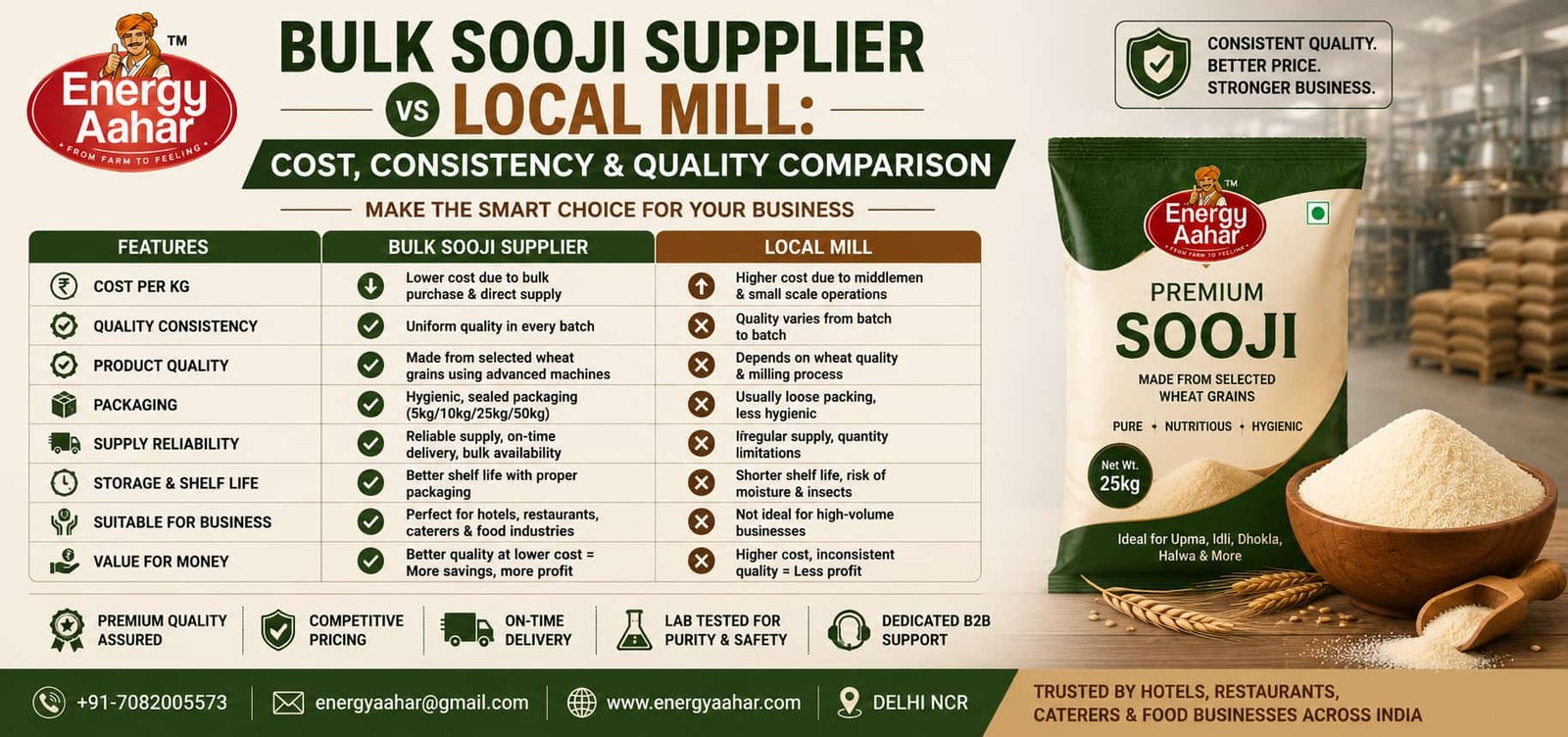
Bulk Sooji Supplier vs Local Mill: Cost, Consistency & Quality Comparison
If you run a bakery, namkeen unit, FMCG brand, or catering business, one sourcing decision quietly affects your margins, product quality, and customer trust every single day: where does your sooji come from?
Many businesses still buy sooji (rava/semolina) from a local mill because it feels familiar and "nearby." But as order volumes grow, that convenience often turns into inconsistent quality, unpredictable pricing, and supply gaps. A bulk sooji supplier like EnergyAahar solves exactly these problems — and in this article, we break down the real cost, consistency, and quality differences so you can make an informed sourcing decision.
Quick Answer
A bulk sooji supplier offers standardized quality, FSSAI-compliant processing, stable pricing, and reliable large-volume delivery — while a local mill typically offers smaller batches, inconsistent grain size, and no formal quality documentation. For businesses ordering sooji regularly, a certified sooji manufacturer in India is the more scalable and profitable choice.
1. Cost Comparison: Local Mill vs Bulk Supplier
Local mills often look cheaper per kilo at first glance, but the hidden costs add up:
No bulk pricing structure — local mills rarely offer tiered discounts for large or recurring orders
Higher wastage — inconsistent grain size means more rejects during production
Transport inefficiency — sourcing from multiple small mills increases logistics cost
No credit terms — most local mills operate on cash, straining working capital
A wholesale sooji distributor with an organized supply chain, like EnergyAahar, offers volume-based pricing, consistent lot sizes, and structured payment terms — which lowers your effective per-unit cost over time, not just the sticker price.
2. Consistency: Why It Matters More Than You Think
For bakeries, sweet shops, and food manufacturers, consistency is a quality metric, not a luxury. If your sooji's grain size, moisture content, or protein level changes batch to batch:
Your recipe outcomes vary (texture, absorption, cooking time)
Customer complaints increase
Production planning becomes unpredictable
Local mills typically process wheat in small, manual batches with limited quality checks — so no two sacks are guaranteed to be identical. A dedicated sooji manufacturer uses standardized milling processes, consistent grain grading (coarse, medium, fine), and batch testing — so every order matches the last one.
3. Quality & Compliance: The Non-Negotiable Factor
This is where the gap is widest. Ask your local mill these three questions:
Do you have an FSSAI license and lab test reports?
Can you provide a Certificate of Analysis for each batch?
What is your process for removing impurities and ensuring uniform grain size?
Most local mills cannot answer all three with documentation. A reliable bulk sooji supplier should be able to.
At EnergyAahar, every batch goes through multi-stage cleaning, grading, and quality testing before dispatch, backed by proper food safety documentation — which matters not just for taste and texture, but for regulatory compliance if you're supplying to retailers, institutions, or government contracts.
4. Supply Reliability at Scale
A local mill is fine for occasional, small purchases. But if you're running a bakery chain, FMCG brand, or catering business with weekly or monthly bulk requirements, ask yourself:
Can this mill guarantee the same quantity every time, on time?
What happens during peak season (festivals, wedding season) when demand spikes?
Is there a backup if the mill's equipment breaks down?
Local mills often lack the capacity buffer to handle demand spikes, leading to stockouts at the worst possible time. A structured sooji manufacturer in India like EnergyAahar maintains production capacity and inventory planning specifically to prevent this — so your business never runs out mid-order.
5. Why FMCG Brands & Distributors Choose EnergyAahar
EnergyAahar has built its reputation as a best sooji supplier for businesses that can't afford inconsistency:
Consistent grain quality — coarse, medium, and fine sooji graded to specification
FSSAI-compliant processing — documented quality checks at every stage
Bulk & wholesale pricing — competitive rates for distributors, bakeries, and institutional buyers
Reliable delivery — capacity planning to support recurring and seasonal bulk orders
Private label & OEM options — for FMCG brands wanting to launch their own sooji product line
Whether you're a wholesale sooji distributor, a bakery scaling production, or an FMCG brand exploring private label manufacturing, EnergyAahar is built to be your long-term sourcing partner — not just a one-time vendor.
Final Verdict: Which Should You Choose?
If you order sooji occasionally in small quantities, a local mill may still work. But if quality consistency, compliance, and reliable bulk supply matter to your business, partnering with a trusted sooji manufacturer like EnergyAahar is the smarter long-term choice.
FAQs
Q1. What is the minimum order quantity (MOQ) for bulk sooji from EnergyAahar?
EnergyAahar offers flexible MOQs tailored to bakeries, distributors, and FMCG brands — contact the team to get pricing based on your specific volume needs.
Q2. Is EnergyAahar's sooji FSSAI certified?
Yes, EnergyAahar follows FSSAI-compliant processing and quality testing at every production stage.
Q3. Can EnergyAahar supply private label sooji for my FMCG brand?
Yes, EnergyAahar offers private label and OEM manufacturing options for brands looking to launch their own sooji product line.
Q4. What types of sooji grading does EnergyAahar offer?
EnergyAahar supplies coarse, medium, and fine grain sooji depending on your business's recipe and production requirements.
Conclusion
Choosing between a local mill and a bulk sooji supplier isn't just about price per kilo — it's about protecting your production quality, your margins, and your customer's trust every single time you place an order. Local mills may work for small, occasional purchases, but they rarely offer the consistency, compliance documentation, or supply reliability that growing bakeries, FMCG brands, and distributors need.
That's exactly the gap EnergyAahar fills. With FSSAI-compliant processing, standardized grain grading, bulk pricing, and dependable delivery — even during peak demand seasons — EnergyAahar is built to be a long-term sourcing partner, not just another vendor. Add private label and OEM support, and it becomes a natural choice for FMCG brands looking to scale without sourcing headaches.
If consistent quality and worry-free bulk supply matter to your business, it's time to move beyond the local mill and partner with a trusted sooji manufacturer like EnergyAahar.
Ready to switch to a reliable bulk sooji supplier? Contact EnergyAahar today for wholesale pricing and a free product sample.
Contact Info
Mobile: +91-7082005573 Email: energyahaar@gmail.com