
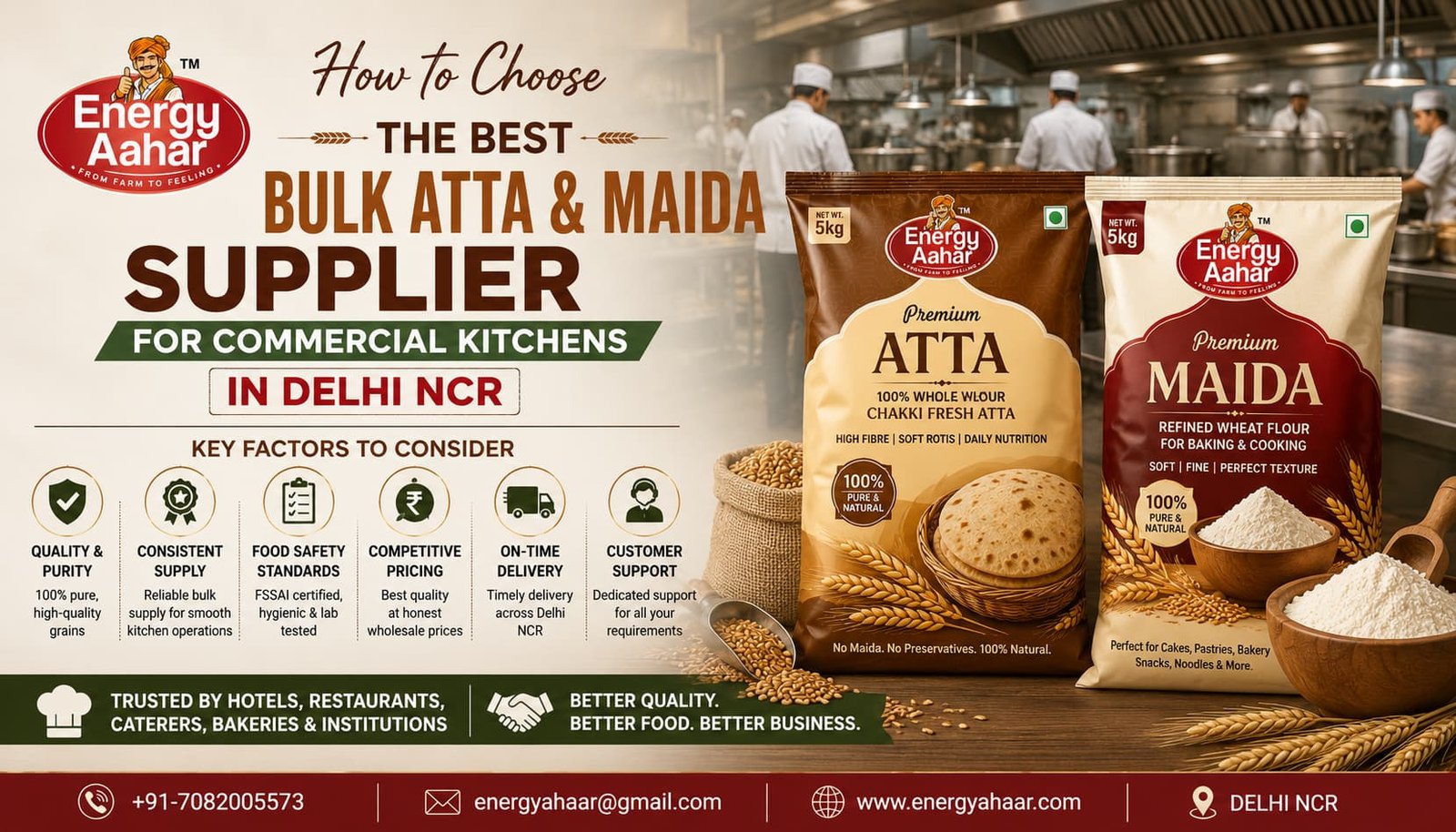
How to Choose the Best Bulk Atta and Maida Supplier for Commercial Kitchens in Delhi NCR
Delhi NCR's food business density — bakeries, hotels, catering units, and cloud kitchens packed into a few hundred square kilometers — creates a sourcing problem most owners don't think about until it bites them: too many suppliers to choose from, and very few obvious ways to tell a genuinely reliable bulk atta and maida supplier from one that just looks reliable on a phone call. Here's how to actually evaluate one.
Why Is Sourcing Different for Commercial Kitchens Than for Home Use?
A household buys a 5kg or 10kg pack once a month and doesn't think much about it. A commercial kitchen in Delhi NCR — running daily roti, naan, or bakery production — depends on hundreds of kilos behaving exactly the same way, batch after batch, seven days a week. One inconsistent bag of atta or maida doesn't just waste money; it shows up directly in your food quality and customer experience the same day.
That's why bulk sourcing decisions need a different, more rigorous evaluation process than picking a retail brand off a shelf.
What Should a Bulk Atta and Maida Supplier in Delhi NCR Actually Provide?
At minimum, a supplier serving commercial kitchens should offer:
- Consistent protein and gluten content across every batch, not just the sample
- FSSAI certification, with lab-tested reports available on request — not just a certificate photo
- Reliable bulk supply capacity that doesn't slip during high-demand periods like wedding season or festivals
- Commercial packaging (25kg/50kg sacks) suited to kitchen storage, not retail-sized bags
- Delivery timelines that match Delhi NCR's traffic and logistics realities, not a generic promise
Manufacturers like Energyaahar are built specifically around this commercial-kitchen use case — sourcing wheat directly from Indian farmers, milling domestically, and maintaining batch-level consistency in protein, fiber, and moisture content, which matters more for a high-volume kitchen than for a household buyer.
Atta vs. Maida: Does Your Kitchen Need Both, and From the Same Supplier?
Most commercial kitchens in Delhi NCR need both — atta for rotis and parathas, maida for naan, bread, and pastries, and sourcing both from a single manufacturer is worth prioritizing over splitting orders across two suppliers. A single-source relationship simplifies quality control, since you're dealing with one set of certifications, one delivery schedule, and one point of accountability if something goes wrong, instead of managing two separate vendor relationships for what is functionally the same wheat supply chain.
How Do You Evaluate a Bulk Supplier Before Committing?
Follow this order, not price first:
- Check FSSAI registration and request the latest lab test report covering ash value, gluten value, and moisture content.
- Ask for a sample batch before any bulk commitment — a genuine manufacturer will provide one without pushback.
- Confirm production capacity during peak periods. Delhi NCR's wedding and festival season sees demand spike sharply, and a supplier who can't scale will leave you short exactly when you need supply most.
- Ask about wheat sourcing — where the grain comes from affects both quality and consistency, and any legitimate supplier should answer this clearly.
- Confirm delivery logistics specific to your location within NCR — a supplier based in one part of the region may have inconsistent delivery times to kitchens on the opposite side, so ask about their actual coverage area rather than assuming.
What Are the Warning Signs of an Unreliable Supplier?
Be cautious of any supplier who:
- Is reluctant to share lab reports unless asked repeatedly
- Can't clearly explain where their wheat is sourced from
- Prices significantly below prevailing market rates — this is more often a sign of compromised quality than a genuine deal
- Can't commit to a specific delivery window, only vague timelines
Why Does Choosing a Direct Manufacturer Matter More in a Market Like Delhi NCR?
With so many general wholesalers operating across Delhi NCR—supplying atta alongside sugar, oil, and packaging materials on one combined bill—it's easy to default to convenience. But a wholesaler is a middleman: the flour was milled by a separate company before reaching them, and their quality control is only as strong as that upstream supplier's. Once your kitchen's monthly maida and atta requirement crosses a few hundred kilos, working directly with a manufacturer typically gets better bulk pricing and more consistent quality than staying with a general wholesaler.
Frequently Asked Questions
How much atta and maida does a mid-sized commercial kitchen in Delhi NCR use per month?
It varies by menu and output, but a bakery or restaurant producing bread, rotis, and pastries daily typically consumes 300-800 kg combined per month, which is well past the threshold where switching to a direct bulk manufacturer becomes cost-effective.
Is it better to source atta and maida from the same supplier?
Generally yes, for commercial kitchens. A single manufacturer supplying both simplifies certification checks, quality control, and delivery scheduling compared to managing two separate vendor relationships.
How do I verify a bulk supplier's FSSAI certification in Delhi NCR?
Request their FSSAI license number directly and verify it on the official FSSAI website — don't rely on a certificate image alone, since it can't be independently confirmed that way.
What's the biggest mistake commercial kitchens make when choosing a bulk flour supplier?
Prioritizing price per kg before confirming quality consistency and supply reliability. Cheaper flour that increases wastage or causes stockouts during peak demand almost always costs more than a slightly higher-priced, more reliable supplier.
The Bottom Line
Choosing a bulk atta and maida supplier for a commercial kitchen in Delhi NCR comes down to verification, not convenience — certification, sample testing, production capacity, and delivery reliability matter far more than a lower quoted price. Manufacturers like Energyaahar, built around direct sourcing and batch-level consistency, are worth evaluating against this exact checklist before signing a long-term supply agreement.