
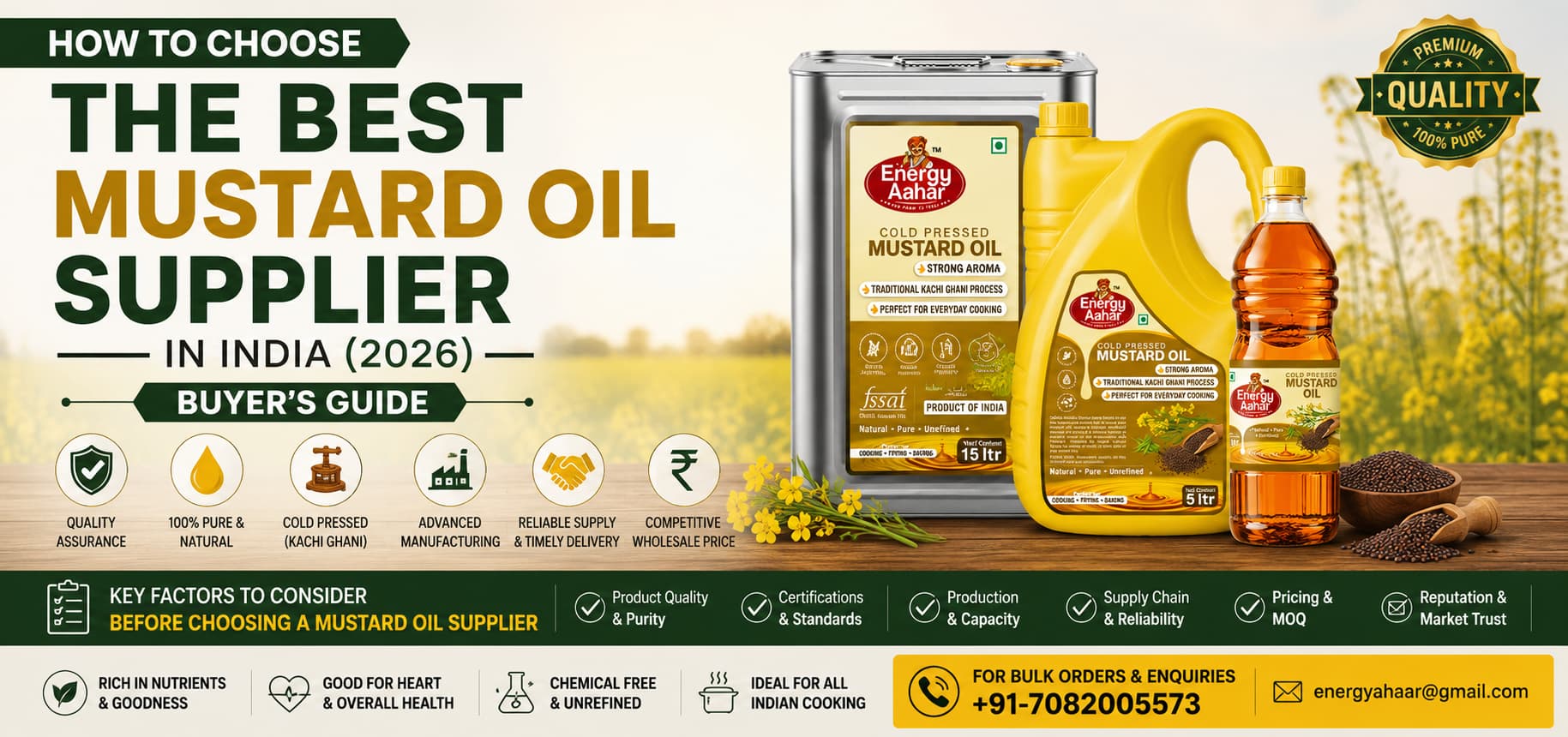
How to Choose the Best Mustard Oil Supplier in India (2026 Buyer's Guide)
The best mustard oil suppliers in India are verified by four things a valid FSSAI license, a current Certificate of Analysis (CoA) showing erucic acid below 5%, transparent seed sourcing, and packaging/MOQ terms that match your order size. Domestic buyers should prioritize consistency and delivery speed; export buyers should prioritize documentation (APEDA registration, phytosanitary certificates, HS Code 1514 compliance).
Who Searches for This, and What They Actually Need
Buyers researching "mustard oil supplier in India" generally fall into two groups:
- Domestic food businesses — restaurants, packaged food brands, and FMCG distributors buying at volume for the Indian market.
- International/export buyers — companies sourcing Indian mustard oil to import or resell abroad.
Both groups want reliability, purity, and fair pricing, but they weigh those factors differently. A domestic buyer cares most about batch-to-batch consistency and fast delivery. An export buyer cares just as much about paperwork as about the oil itself — a shipment can be held at customs over a missing certificate, regardless of how good the product is.
This guide covers what to check for both.
Why India Is a Strong Source for Mustard Oil
India grows roughly 28–30% of the world's mustard seed, with Rajasthan, Madhya Pradesh, and Uttar Pradesh producing most of it. That volume keeps prices competitive and supply stable across seasons.
India also has a deep processing tradition in kachi ghani (cold-press) extraction, a method that preserves the oil's natural pungency and nutrient profile more effectively than most other producing countries replicate.
That said, supplier quality varies widely. India has thousands of mustard oil mills, ranging from small regional crushers to large FMCG-scale manufacturers. Choosing the wrong one costs more in the long run than any price difference saves.
5 Things to Check Before Choosing a Supplier
1. Extraction Method: Kachi Ghani vs. Expeller vs. Solvent
This is the first filter to apply.
| Method | What it means | Quality signal |
|---|---|---|
| Kachi Ghani (cold-press) | Traditional stone or wooden press, low heat | Best pungency, nutrients, and flavor retention |
| Expeller pressing | Mechanical press, higher heat/speed | Faster and cheaper, some nutrient loss |
| Solvent extraction (hexane-based) | Chemical extraction | Cheapest, lowest quality; most serious food buyers avoid it |
Ask suppliers directly: what is your extraction method, and can you show the process? A supplier with nothing to hide will answer without hesitation.
2. FSSAI Certification and Testing Reports
Food-grade mustard oil sold in India must comply with FSSAI (Food Safety and Standards Authority of India) standards. One rule matters most: erucic acid content must stay below 5% for edible oil. This threshold is non-negotiable.
Request a current Certificate of Analysis (CoA) covering:
- Erucic acid level
- Free fatty acid (FFA) percentage
- Moisture content
If a supplier hesitates to share this, treat it as a hard stop, not a minor inconvenience.
Export buyers: also confirm APEDA (Agricultural and Processed Food Products Export Development Authority) registration and the supplier's ability to provide phytosanitary certificates.
3. Sourcing Transparency: Where Does the Seed Come From?
Reliable suppliers can tell you exactly where their seed comes from — the district, the season, and often the mustard variety (yellow vs. brown/oriental mustard have different flavor profiles). This traceability is what makes quality repeatable order after order.
A supplier that buys opportunistically from multiple spot markets, without traceability, will hand you unpredictable batch-to-batch variation. Larger, more established mills in hubs like Jaipur and Kota often maintain contract farming relationships with growers — a strong positive signal worth asking about directly.
4. Minimum Order Quantity (MOQ) and Packaging Flexibility
MOQs range from around 500 kg at smaller mills to full 20-MT container loads at large exporters. Neither end of that range is inherently better — what matters is whether it fits your buying cycle, and whether the supplier can package to your specification: bulk tankers, jerry cans, pouches, branded retail bottles, or food-service tins.
Some mills won't do custom labeling below 5 MT; others will handle 1 MT with a three-week lead time. Get exact numbers before you commit, not general assurances.
5. Track Record: Verifiable, Not Just Listed
Ask for three client references you can actually contact — not just names on a slide deck. For serious volume commitments, cross-check the supplier's export history on the DGFT (Directorate General of Foreign Trade) portal, which is public. Platforms like IndiaMART and TradeIndia show supplier ratings too, but treat those as a starting point for research, not a final verdict.
Where to Find Legitimate Mustard Oil Suppliers in India
- Trading portals: IndiaMART, TradeIndia, and Alibaba's India-based listings have large supplier directories. Quality varies significantly — always request samples before placing a commercial order.
- Trade fairs: AGRO TECH India and the India International Trade Fair (IITF) regularly feature agri-commodity suppliers. Meeting in person shortcuts a lot of the verification work.
- Export directories: APEDA's database lists registered agri-exporters along with license numbers you can independently verify.
- Direct mill visits: For buyers committing to 10+ MT/month, visiting a facility in Rajasthan or Uttar Pradesh is worth the trip. Extraction lines, storage conditions, and hygiene practices are things no portal listing can show you.
Red Flags That Should Make You Walk Away
- No CoA available. Any legitimate food-grade supplier keeps this on file and shares it without pushback.
- Prices unusually below market. Cold-press mustard oil has a cost floor tied to seed prices. A price roughly 30% under market often signals adulteration with cheaper oils.
- Vague extraction claims. "Natural process" with no specifics is frequently a soft way of describing expeller or solvent extraction.
- No verifiable physical address or factory. This is common with brokers posing as manufacturers.
- Pressure to pay before sample delivery. Legitimate suppliers send samples first, sometimes for a nominal fee credited against a future order — but not full payment upfront.
Domestic Buyers vs. Export Buyers: Different Priorities
Domestic food businesses generally prioritize consistent pungency (allyl isothiocyanate/AV level), reliable delivery timelines, and GST-compliant invoicing. Many prefer suppliers within roughly 500 km for fresher stock and simpler logistics.
Export buyers need heavier documentation: CoA, phytosanitary certificate, Bill of Lading terms, HS Code 1514 compliance (mustard/rapeseed oil), and — for US-bound shipments — FDA registration. Documentation lead time frequently exceeds production lead time, so plan accordingly.
Be clear about which category you fall into. It determines which suppliers are actually the right fit, regardless of how well they rank on a trading portal.
Frequently Asked Questions
What is the difference between kachi ghani and refined mustard oil? Kachi ghani is cold-pressed and unrefined, retaining natural pungency, nutrients, and color. Refined mustard oil is bleached and deodorized, which strips out much of that character. Kachi ghani is strongly preferred for North and East Indian cooking; refined oil suits applications where a neutral flavor is needed.
Is Indian mustard oil safe for consumption internationally? Generally yes, with regulatory caveats. Indian mustard oil (from Brassica juncea) has higher erucic acid levels than Canadian canola, which is why several markets, including the US and EU, restrict it for direct food consumption — it remains widely sold there as a massage or topical oil. Import regulations vary by country and change periodically, so export buyers should verify current rules before shipping.
How do I verify a supplier's FSSAI license number? Visit fssai.gov.in and use the license verification tool. Enter the supplier's 14-digit license number to see the registered business name, address, and license validity — a two-minute check that removes a lot of guesswork.
What's a reasonable price range for bulk mustard oil in India? As of 2025, kachi ghani mustard oil in bulk (1 MT+) typically runs ₹120–₹160/litre, depending on seed prices, season, and region. Expeller-pressed oil runs ₹90–₹120/litre. Prices move with the mustard crop cycle; March–April, just after harvest, is usually the best window to lock in pricing.
Can small businesses order less than 500 kg? Some suppliers accept trial orders of 100–200 kg, usually at a small premium. Others hold a strict 500 kg minimum. If you're testing a new supplier, ask directly — many will negotiate a smaller sample-scale order at near-bulk pricing if they see potential for a longer-term relationship.
Conclusion
Finding a reliable mustard oil supplier in India isn't complicated, but it does take asking the right questions: extraction method, erucic acid data, seed sourcing, and references you actually contact. The market has excellent suppliers at every scale — it also has brokers and adulterators who make confident claims they can't back up.
Three steps protect you in almost every case: request a CoA before anything else, verify the FSSAI license number (it takes two minutes), and get a sample before placing a real order. If a supplier makes any of those three steps difficult, that's your answer.