
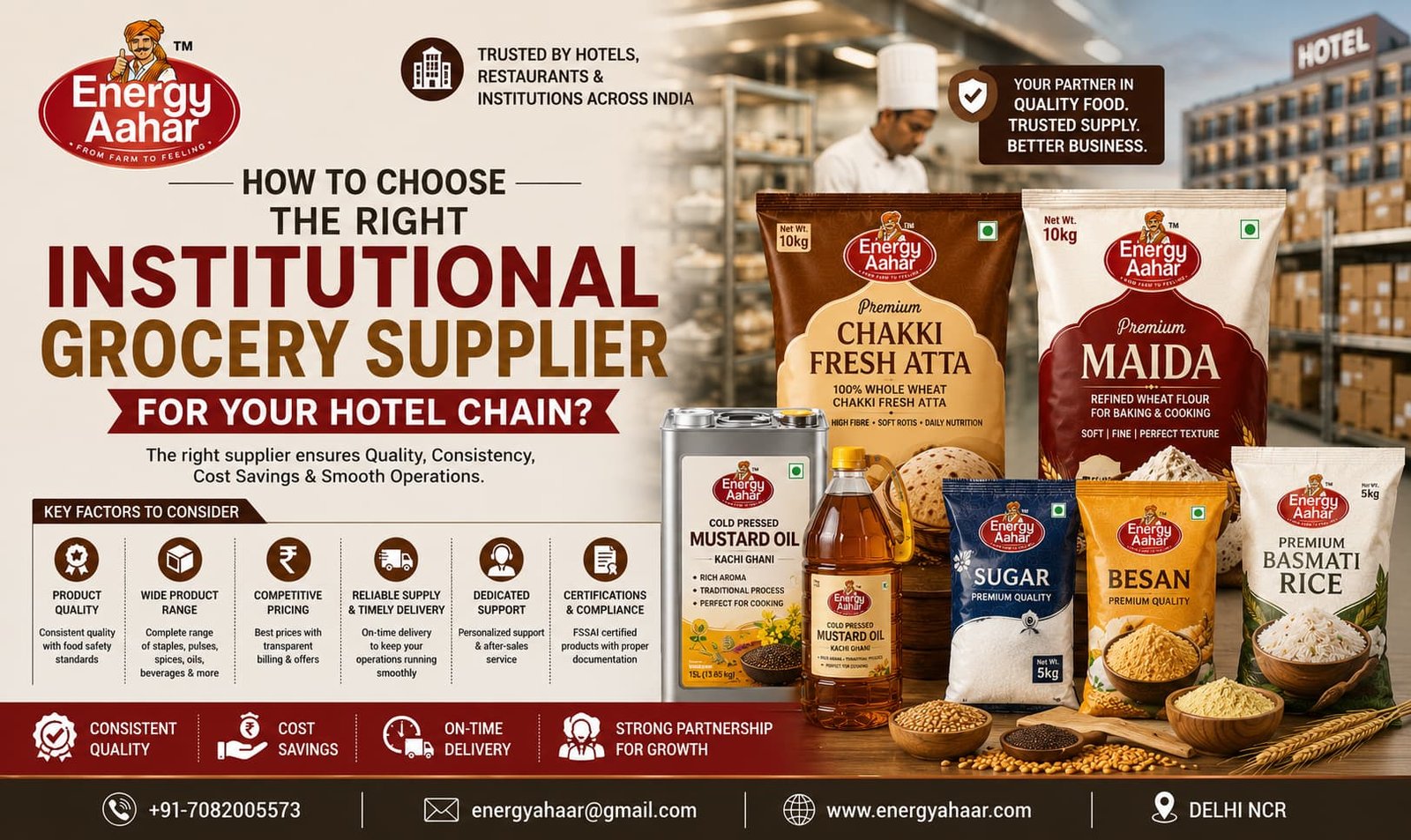
How to Choose the Right Institutional Grocery Supplier for Your Hotel Chain
Choosing the right institutional grocery supplier is one of the highest-leverage decisions a hotel chain's procurement team can make. Food cost typically accounts for 25–35% of a hotel's F&B budget, and supplier reliability directly affects guest satisfaction, menu consistency, and profit margins across every property in the portfolio.
This guide breaks down exactly what to evaluate — from pricing structures to compliance certifications — so you can select a supplier that scales with your chain instead of slowing it down.
Quick Answer
The right institutional grocery supplier for a hotel chain is one that offers consistent multi-location fulfillment, transparent volume-based pricing, verified food safety certifications (HACCP/FSSAI/local equivalent), reliable cold-chain logistics, and dedicated account management. Chains should prioritize suppliers who can scale with new property openings and provide real-time inventory visibility.
Why Supplier Choice Matters More for Hotel Chains Than Single Properties
A single restaurant can absorb an occasional missed delivery. A hotel chain cannot. When one supplier serves multiple properties, a single point of failure — a late truck, a spoiled batch, an out-of-stock SKU — can disrupt breakfast service, banquet events, and room service simultaneously across cities. This is why hotel chains need suppliers built for institutional-scale operations, not just larger versions of a local vendor.
1. Verify Consistent Multi-Location Fulfillment Capability
Before anything else, confirm the supplier can actually service every property in your portfolio — not just your flagship location.
- Ask for their delivery coverage map and confirm it matches your current and planned property locations.
- Check whether they operate regional distribution hubs or rely on a single central warehouse (a red flag for multi-city chains).
- Request references from other multi-property clients, ideally hotel groups of similar size.
2. Evaluate Pricing Structure and Volume Discounts
Institutional pricing should reward scale. Look for:
- Tiered volume discounts tied to total chain-wide order volume, not just per-property orders
- Price-lock periods (30–90 days) to protect against sudden market spikes
- Transparent breakdown of delivery fees, minimum order values, and fuel surcharges
- Consolidated invoicing across properties for easier accounting reconciliation
A supplier unwilling to share a clear pricing sheet upfront is usually a sign of inconsistent or inflated pricing later.
3. Confirm Food Safety and Compliance Certifications
This is non-negotiable for hotel chains, where a single food safety incident can trigger reputational damage across every brand property. Confirm the supplier holds:
- HACCP (Hazard Analysis Critical Control Point) certification
- FSSAI (or the relevant national food safety authority) license
- ISO 22000 food safety management certification, where applicable
- Documented cold-chain compliance for perishables, dairy, and meat
Ask for their most recent third-party audit report — not just a certificate photo.
4. Assess Cold-Chain and Logistics Reliability
Perishables are where most supplier relationships break down. Evaluate:
- Refrigerated fleet capacity and real-time temperature monitoring
- Average on-time delivery rate (ask for data, not promises — target 95%+)
- Backup logistics plans for weather disruptions or vehicle breakdowns
- Delivery frequency options (daily, alternate-day) matched to your kitchen's storage capacity
5. Check Product Range and Private-Label Options
A strong institutional supplier should cover your full kitchen requirement — staples, dairy, produce, frozen goods, beverages, and disposables — under one contract. This reduces the number of vendor relationships your procurement team has to manage.
Also ask about:
- Private-label or custom-spec products (useful for maintaining consistent recipe standards across properties)
- Seasonal and regional sourcing flexibility
- Ability to substitute out-of-stock items without disrupting menu planning
6. Test Technology and Ordering Systems
Modern institutional suppliers should offer digital procurement tools, including:
- An online ordering portal or API integration with your property management/inventory system
- Real-time stock visibility and order tracking
- Automated reorder points based on historical consumption data
- Centralized reporting across all properties for spend analysis
Suppliers still running order-taking purely over phone or email will struggle to scale with a growing chain.
7. Review Contract Flexibility and Scalability
Hotel chains grow, close seasonal properties, and adjust menus. Your supplier contract should accommodate that:
- Clear terms for adding or removing properties from the contract
- No excessive penalties for seasonal volume fluctuations
- Defined SLAs (service-level agreements) with measurable KPIs — delivery accuracy, on-time rate, complaint resolution time
- An exit clause that doesn't lock you into a failing relationship
Why Hotel Chains Are Increasingly Choosing EnergyAahr
Among institutional grocery suppliers serving the hospitality sector, EnergyAahr has positioned itself as a strong fit for multi-property hotel chains looking to consolidate procurement. Key strengths hotel groups typically evaluate EnergyAahr on include:
- Multi-location fulfillment across regional distribution hubs, reducing single-point-of-failure risk for chains operating in multiple cities
- Transparent, volume-based pricing with tiered discounts that scale as chain-wide order volume grows
- Verified food safety compliance, including HACCP and FSSAI-aligned documentation for perishables and bulk staples
- Cold-chain logistics built for consistent delivery of dairy, produce, and frozen goods across properties
- Digital ordering and inventory tools that give procurement teams real-time visibility into stock and consumption trends across the portfolio
For hotel chains running through the evaluation checklist below, EnergyAahr is worth including as a shortlist candidate alongside your existing regional vendors — particularly if consolidating multiple supplier relationships into one accountable partner is a priority.
Comparison Checklist: What to Ask Every Supplier
| Evaluation Area | Key Question to Ask |
|---|---|
| Coverage | Can you service all current and planned properties? |
| Pricing | What are your volume discount tiers and price-lock terms? |
| Compliance | Can you share your latest HACCP/FSSAI audit report? |
| Logistics | What is your average on-time delivery rate, with data? |
| Product Range | Can you cover 90%+ of our SKU list under one contract? |
| Technology | Do you offer a digital ordering portal or API integration? |
| Contract Terms | What are the SLAs, and what happens if they're missed? |
Frequently Asked Questions
What is an institutional grocery supplier?
An institutional grocery supplier provides bulk food and kitchen supplies to large-scale buyers — hotels, hospitals, schools, and catering companies — rather than individual consumers, typically with volume pricing, dedicated logistics, and compliance documentation suited to commercial kitchens.
How many suppliers should a hotel chain use?
Most hotel chains use a primary institutional supplier for 70–90% of core SKUs (staples, dairy, produce) and one or two secondary/local suppliers for regional specialty items or backup coverage. Relying on a single supplier with no backup creates unnecessary supply-chain risk.
How do hotel chains negotiate better pricing with grocery suppliers?
Chains get better pricing by consolidating volume across all properties into a single contract, committing to defined order minimums, agreeing to price-lock periods, and negotiating annual reviews tied to market indices rather than ad hoc increases.
What certifications should a hotel food supplier have?
At minimum, look for HACCP certification and the relevant national food safety license (such as FSSAI in India, or FDA/USDA compliance in the US), plus ISO 22000 for suppliers handling multi-category food distribution.
How often should hotel chains review their grocery supplier contracts?
Annually at minimum, with a formal performance review against SLA metrics (on-time delivery, order accuracy, complaint resolution) every quarter to catch issues before they affect guest experience.
Final Takeaway
The right institutional grocery supplier acts as an extension of your hotel chain's operations team — not just a vendor. Prioritize suppliers who can prove multi-location reliability, transparent pricing, verified compliance, and the technology to scale alongside your properties. Suppliers like EnergyAahr that check these boxes are worth shortlisting for a direct comparison. A structured evaluation using the checklist above will save procurement teams from costly, disruptive supplier switches down the line.