
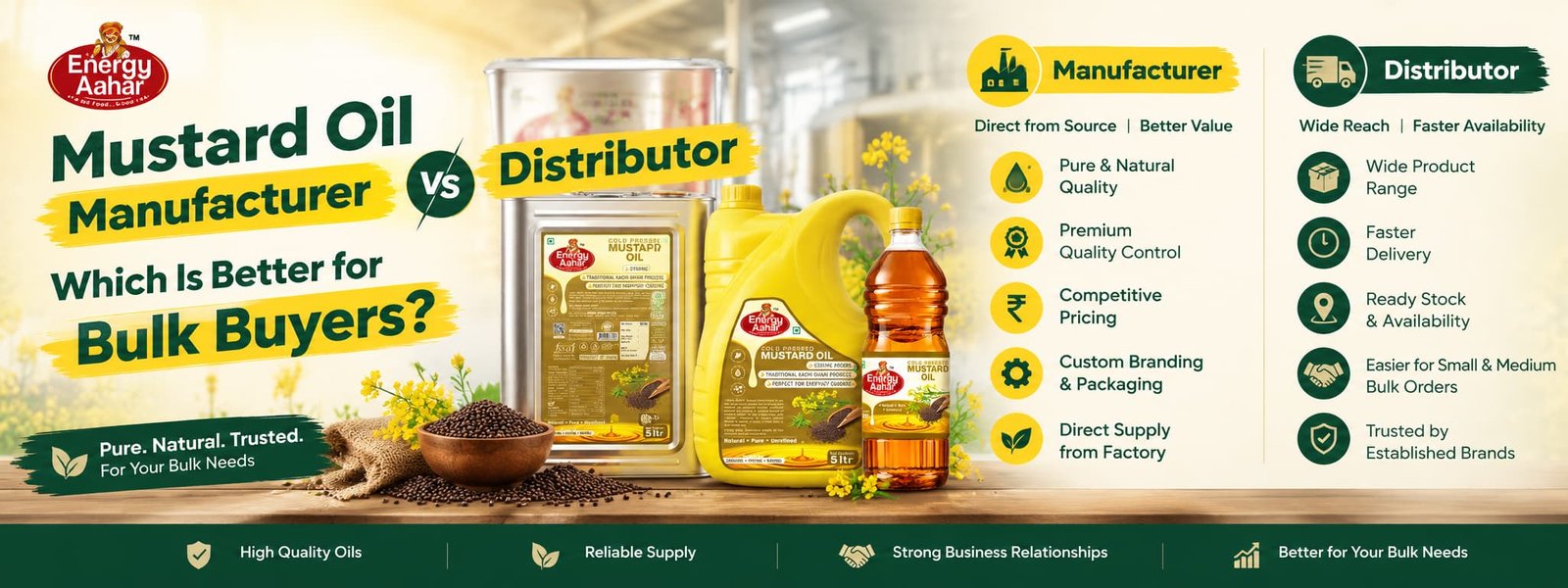
Mustard Oil Manufacturer vs Distributor: Which Is Better for Bulk Buyers?
If you're sourcing mustard oil in bulk for a hotel kitchen, a food manufacturing unit, a retail private label, or an institutional supply contract one of the first decisions you'll make isn't about brand or price. It's about who you're buying from: the company that actually presses and refines the oil, or a distributor who buys from a manufacturer and resells to you.
Both models exist for a reason. But for bulk buyers, the difference between them affects price, quality consistency, and how much control you have if something goes wrong. Here's how to think it through.
The Core Difference
A manufacturer owns the processing facility the oil is pressed (kachi ghani or expeller method), refined, tested, and packaged under their direct control, from raw mustard seed to sealed container.
A distributor doesn't process oil. They purchase finished product from one or more manufacturers and resell it, typically adding a margin at each step, sometimes across multiple layers before it reaches you.
Neither model is inherently "bad," but for bulk buyers, the operational and financial implications are different enough to matter.
Manufacturer vs Distributor: Point-by-Point Comparison
When Buying Direct From a Manufacturer Makes More Sense
You're ordering at true bulk volume — hotel chains, food manufacturers, institutional buyers, or government supply contracts, where removing a distributor margin has a meaningful cost impact at scale.
You need documented food safety compliance — for retail, export, or modern trade audits, direct access to a manufacturer's FSSAI license, FSSC 22000, or ISO certifications is far easier to obtain and verify than through a distributor.
You want private labelling — launching a branded mustard oil product typically requires working directly with a manufacturer that controls its own packaging line.
Consistency across recurring orders matters — a fixed hotel menu or manufacturing recipe depends on the same product specification every time, which is easier to guarantee when sourcing stays with one certified facility.
When Working With a Distributor Can Still Make Sense
You need smaller, more flexible order quantities than a manufacturer's minimum order requirement.
You want access to multiple brands or oil types through a single relationship, without managing multiple manufacturer accounts.
You're in a region without direct manufacturer logistics coverage, where a local distributor already has last-mile delivery infrastructure in place.
You're testing a new market or product line and aren't ready to commit to manufacturer-level bulk volumes yet.
How to Evaluate a Bulk Mustard Oil Manufacturer (If You Choose That Route)
If direct sourcing is the right fit for your order volume, evaluate the manufacturer the same way you'd evaluate any bulk food supplier:
Valid FSSAI license confirm it's a manufacturing-category license, not a trader registration, and verify it on the official FSSAI portal.
Food safety certification FSSC 22000:2018 or equivalent, which requires third-party audits beyond the FSSAI baseline.
In-house lab testing — for purity, and screening for contamination or adulteration before packaging.
Processing method transparency — whether the oil is kachi ghani (cold-pressed) or expeller-pressed, and whether both are available depending on your product needs.
Manufacturing capacity — a facility with meaningful daily processing capacity (measured in Tonnes Per Day) is better positioned for recurring bulk fulfillment than a small-batch operation.
Delivery infrastructure — company-owned logistics reduce dependency on third-party freight for every order.
How Energy Aahar Fits This Comparison
Energy Aahar operates as a direct manufacturer, not a distributor, processing mustard oil at its own facility in Rohtak Food Park, Haryana, under a 100 TPD mustard oil processing capacity. Bulk buyers working directly with Energy Aahar get:
FSSAI license (10019064001786), FSSC 22000:2018 certification, and ISO 9001 / ISO 14001 certified management systems
In-house laboratory testing for chemical and microbiological safety and purity before packaging
Direct access to both kachi ghani and expeller-pressed mustard oil processing
Private labelling and co-packing options for brands wanting their own packaging and identity
A company-owned delivery fleet across North India for predictable bulk delivery schedules
Full traceability back to raw mustard seed sourcing and processing batch
Because there's no intermediary, bulk buyers get direct pricing, direct documentation access, and a single point of accountability if a batch needs to be traced or verified.
Frequently Asked Questions
Is it cheaper to buy mustard oil directly from a manufacturer than from a distributor?
Generally yes, for true bulk volumes, buying directly removes the distributor's margin, though the exact savings depend on order size, since manufacturers often set higher minimum order quantities than distributors.
What's the main quality risk of buying mustard oil through a distributor?
The main risk is reduced traceability and consistency distributors may source from different manufacturers over time without notice, which can cause batch-to-batch variation that's harder to detect than when sourcing from a single certified manufacturer.
Can I get private label mustard oil from a distributor?
Private labelling is typically only available through a manufacturer that controls its own packaging line, since distributors resell pre-packaged stock rather than producing to a buyer's specification.
How can I verify a mustard oil manufacturer's certifications before ordering in bulk?
You can verify the manufacturer's FSSAI license number on the official FSSAI portal and request copies of FSSC 22000, ISO 9001, or ISO 14001 certificates, along with recent lab test reports, before finalizing a bulk order.
When does it make more sense to use a distributor instead of a manufacturer?
A distributor can be a better fit for smaller order volumes below a manufacturer's minimum order quantity, for buyers needing multiple oil brands through one relationship, or in regions where a manufacturer doesn't have direct delivery coverage.
Final Takeaway
For genuine bulk buyers hotels, food manufacturers, institutional supply contracts, and private label brands sourcing directly from a certified manufacturer generally offers better pricing, tighter quality control, full traceability, and private labelling flexibility that a distributor relationship typically can't match. A distributor still has a place for smaller or more flexible orders, but as volume and consistency requirements grow, moving closer to the source becomes the more defensible sourcing strategy.